The prestigious silversmith "Bernard Family" continuing since the 18th century
Posted by WATANABETAIGA

The Barnards Family, Britain's Oldest Silversmiths
The Barnards family were British silversmiths active from the 18th to the 20th centuries.
The Barnards family is known as a distinguished name in the history of British silverware, having produced numerous masterpieces from the Georgian era through the Victorian era.
History
The Origins of the Workshop Dating Back to Around 1680
The origins of the Barnards family company are said to trace back to the workshop of Anthony Elmes, a legendary British silversmith established around 1680.
This is why it is said to be Britain's oldest silversmith.
The company founded by Anthony Elmes was merged with the company run by Thomas Wipham in 1739 and later with the company run by Thomas Chawner in 1786, greatly expanding its scale.
The first of the Barnards family, Edward Barnards I, was an apprentice of Thomas Chawner, and Edward Barnards I's second son greatly contributed to the company as its foreman.
1829: The Beginning of the Barnards Family
Subsequently, in 1829, Edward Barnards I and his sons took over the management of the company, which became "Edward Barnards & Sons," marking the beginning of the Barnards family.
The company became a subsidiary of "Paget & Bramah" in 1977 and was completely closed in 2003.
Product Features
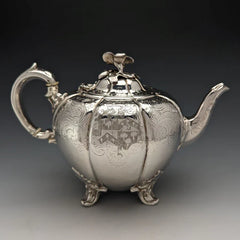
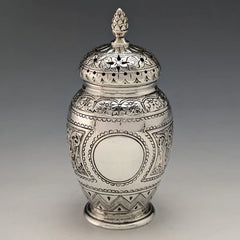
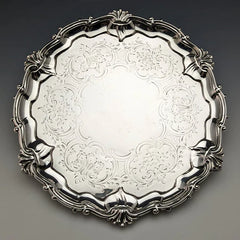
Since the time of Anthony Elmes, the Barnards family has continued to create high-end silverware for royalty and the upper aristocracy, and its quality has always remained at a high standard.
Teasets and trays are particularly popular.
They are characterized by elegant and sophisticated designs in Neoclassical and Rococo styles, tailored to the style of each era.
Representative Works
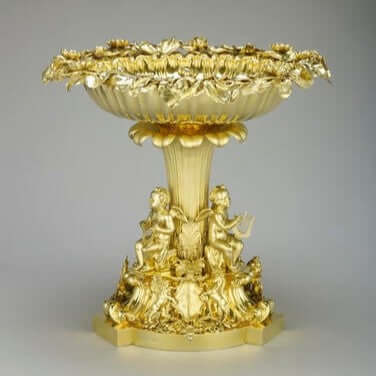
The British Royal Baptismal Font "LilyFont"
Among its masterpieces is the baptismal font known as "LilyFont," which was commissioned in 1840 when Queen Victoria had her first daughter.
A baptismal font is a container used to hold water for Christian baptism ceremonies.
It is a large piece weighing nearly 10 kg, featuring a bowl beautifully decorated with water lilies and leaves, and is made of sterling silver with gold plating.
The central stem is shaped like a lily, and three angels playing harps sit on the circular base.
It is kept in the Jewel House at the Tower of London as part of the Royal Collection and has been used in British royal baptisms since 1841.
Summary
Many works by the Barnards family are housed in renowned museums such as the Victoria and Albert Museum and the British Museum in London.
As the pinnacle of British silverware, it continues to captivate many people to this day.